
Tommy "Bullets" Cahill
And the spirit of St. Louis soccer.

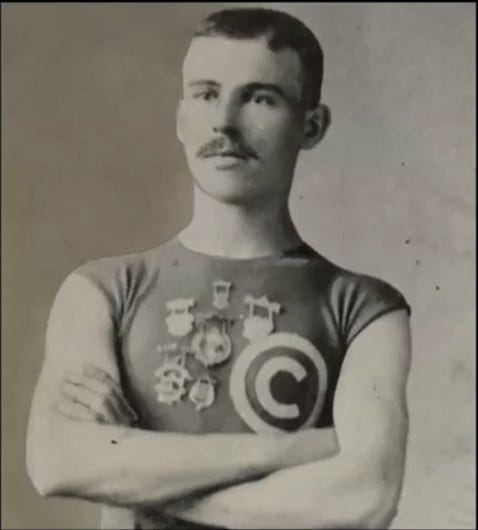
St. Louis, 1884
Tommy “Bullets” Cahill got his nickname from getting shot twice by his father-in-law. Plenty of other people loved him, though, and whatever we think, he was the founder of the USMNT. He had his flaws, but in the end he was a good man. Although, the truth is he may not have been. One of his descendants says pretty point blank, “He was not a good man.” We needn’t decide. We can chalk it up to his environment and table the issue.
“Tom Cahill gave his all for soccer.” That’s what Cahill told a reporter he wanted inscribed on his statue. It was not unusual then to propose a statue to yourself. First soccer game Cahill ever saw he’d have walked past a statue-to-yourself of the still living St. Louis baseball promoter Von der Ahe. The game was by a group of Canadian-Scots playing in the new scientific style.
Historian Ged O’Brien says this style’s development was helped along in Scotland by the legacy of the Scottish Enlightenment, and now expats were spreading the new way of play around the world. Cahill went to see what the ballyhoo was about and concluded, “I haven’t been able to give up the game since...” The Scottish visitors, the newspaper reporter, had put on a great display of movement and teamwork.
The Scottish Enlightenment
There is the risk of leaning too heavily into the SE to reconstruct the game Cahill saw, but Thomas Reid’s common sense was without question in play, foundational even. In the old, English style, a lone man rushed into a pit of defenders in a chaotic fit of self-will. They Scottish saw and asked themselves: Is it not better we kick away from the pit and toward a teammate? Perhaps we can then go around it, or that our kick will disperse it, and in this way we can then go through.
This became a sense common to the team, and passing was invented. You might also see that this decoupling of man and ball created a new kind of moral sense -- passer and pass receiver in mutual sympathy, the game played all together for the viewing of one imagined impartial observer, soccer itself. But you don’t have to see this; the influence of the SE is always a matter of personal preference.
The mental gravity of St. Louis
Cahill’s full memory of the Christmas Day game was this: “I haven’t been able to give up the sport since. It is the most exciting sport one can possibly imagine, and when the weather is very cold, the spectators’ blood will boil and he is heated up with his own enthusiasm. I get so excited myself that I often kick some spectator on the shins; I’m so worked up that I don’t know what I’m doing.” Cahill, it seems, responded more to the game’s passion than to its sympathy and science.
A bit after seeing the Christmas Day game, for instance, Cahill assaulted the president of his sports club when he wouldn’t let him register in a distance race he was keen on. He hid outside and got him good. Hit him in the face before he even knew what was happening. After that he tried to fix a soccer match against his own team, again out of a dispute with the club president. Then of course there was the brawl with the Jefferson Guard at the World’s Fair. There are many more examples, but we needn’t go on; his passion I think is beyond reproach.
To find the influence of the scientific style then we need to look at soccer itself. Unfortunately, in the years after the visitors left, the local league kept collapsing into brawls. Gentlemen like the honorable Mr. Peckington withdrew trophy after trophy in disgust. Looking at all the facts it’s hard to see that the soccer itself of the visitors had any influence on St. Louis at all.
I think I see what happened. Cahill got shot twice by his father-in-law (now maybe you can understand better why), and everyone more or less laughed it off. And I wrote to you last year about an earlier game in St. Louis. Three different players from that game later died in honor killings. This mental gravity – in Hume’s conception, the force guiding how simple ideas were going to associate – pulled St. Louis soccer in a rougher direction. “Soccer is a rollicking, devil-may-care sort of a sport, and it is probable that in this very recklessness its greatest attraction lies,” understood the leading local newspaper.
St. Louis soccer would mature into one of our great soccer cities, but always along the rougher lines of earlier times. And Cahill would head east with its passion. This was for a war he wanted to have with the soccer establishment there. Out of that war would come our national federation, for better or worse.